Pittsburgh, 1913 · Camarillo, 2010
His Story
Who John Lauten was, where the war took him, and what he did on D-Day.
Who He Was
Pittsburgh, 1913 · Camarillo, 2010John Lauten was born in Pittsburgh on August 17, 1913, and grew up in Glendale, California, after his family moved there in 1927. He studied political science at UCLA, where ROTC made him a second lieutenant, and earned his law degree at Boalt Hall in 1938. That same week he married Virginia “Ginny,” whom he had met in Berkeley.
In 1942 he was a deputy city attorney in Glendale with a daughter not yet two. He reported for duty that February and joined the 16th Infantry Regiment of the 1st Infantry Division, the “Big Red One,” as a platoon leader.
- Nov. 1942 · AlgeriaLanded near Oran in the invasion of North Africa. Bronze Star.
- 1943 · TunisiaKasserine Pass, Gafsa and El Guettar. Became the regiment's intelligence officer (S-2) that spring.
- July 1943 · SicilyAssault landing at Gela, then the march inland toward Mount Etna.
- June 6, 1944 · NormandyLanded on Omaha Beach with the regiment that led the first wave. Silver Star.
- 1944 to 1945 · GermanyThe Hürtgen Forest, the Battle of the Bulge and the drive into Germany. The war ended with the division in Czechoslovakia.
- 1945 · HomeDischarged as a lieutenant colonel. Also awarded the Czech Military Cross and the French Croix de Guerre.
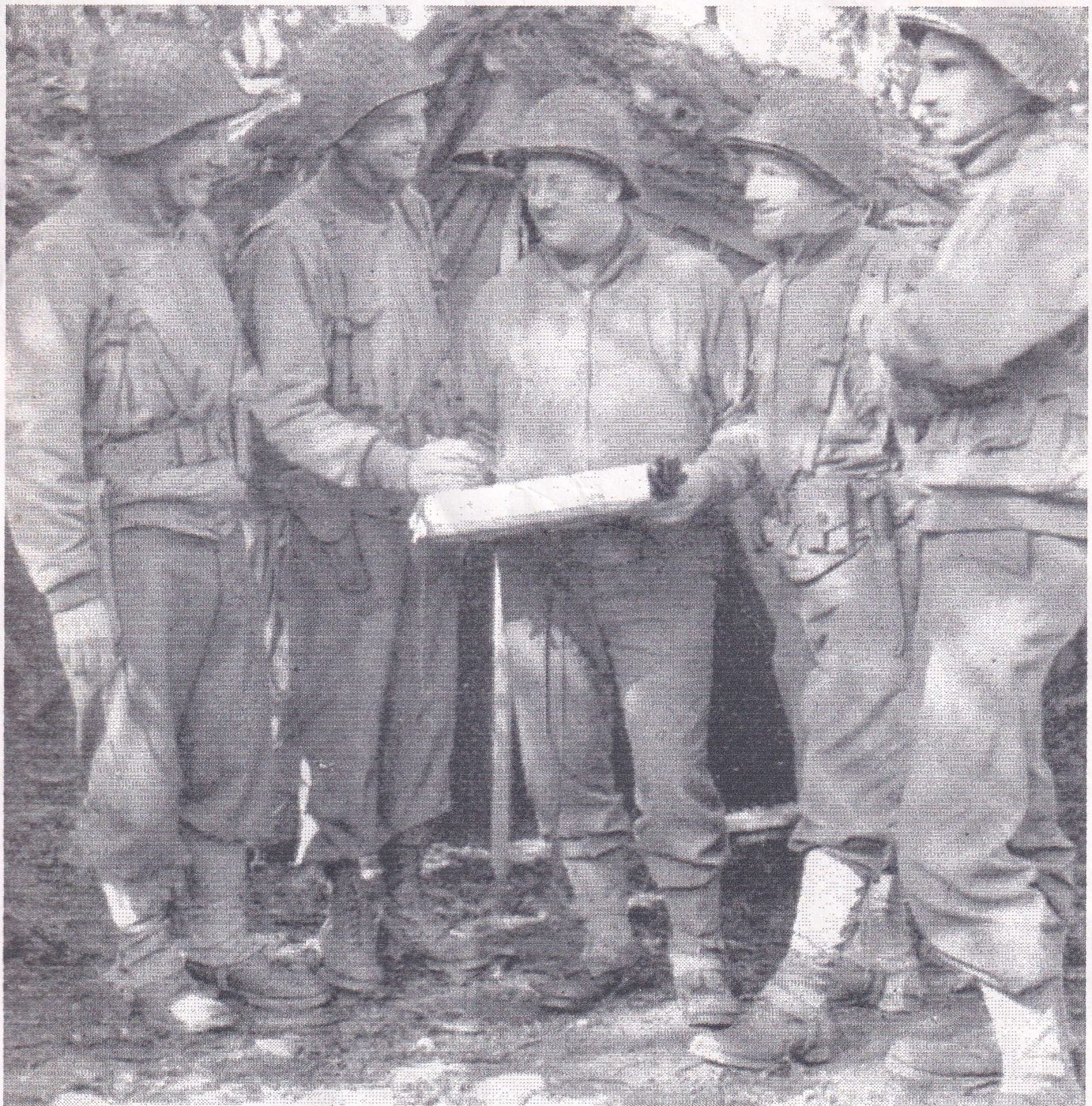
D-Day
As intelligence officer (S-2) of the 16th Infantry, the regiment chosen to lead the 1st Division onto Omaha Beach, he was one of the few officers cleared to see the invasion plans, maps and aerial photographs.
He was one of five officers who planned the regiment’s assault on Omaha Beach. The overall plan for Normandy came from the top, but each assault regiment planned its own landing: which companies went in where, in what order, and what they would meet on the sand. His part was the enemy: the German positions, guns and beach obstacles, pieced together from aerial photographs and intelligence reports.
He landed with the regiment on D-Day and earned the Silver Star for rallying troops on the exposed beach under fire.
He never bragged about any of it. His job, he said later, “was not to shoot Germans but to determine what the military situation was.” Asked about the war, he would say only that he did what he had to do.
“If you were to draw it on a map, the ‘Big Red One’ was always the finger of any forward thrust.”
After the war he went back to law: assistant city attorney of Glendale, city attorney of Fresno, then general counsel of the Metropolitan Water District of Southern California. In 1974 he became its general manager, the first non-engineer to hold the job, and led it through the drought of 1976 and 1977. He died in March 2010.